

This will probably be a shorter less-structured write-up, but a lot has changed for me in the last year. Not good or bad, just different and warranting in my opinion some introspection. I think that there's just a lot of things I need to externalize through some form to be able to zoom out, and perhaps writing is the best so I can look back in the future and say "wow that was silly," and laugh.
I don't promise anything to learn, nor any profound thoughts, but I can say that this may be useful for those that are undergoing some similar changes in career that may find such thoughts comforting. So with that I will just lay out the changes I have encountered in this year alone:
- I left my current job
- I changed industries
- I changed where I spend my free-time
Changing Jobs
This is not some magnanimous announcement I expect people to shudder over. It was a choice I made like many people make, and it was a good time to do so after 5 years. My previous company gave a lot in terms of friendships, fun challenges, and ways of thinking about solving problems with other people that may not share your view. What I think hits hardest is the fact that you do leave some comforts behind and of course some people too. There are unfortunately those few that are just awesome to converse with on the job, but will not be seen outside of it for various reasons. In my case because many times they are outside of the country and quite hard to take a coffee with otherwise. I will miss interacting with them more than just an occasional post on LinkedIn.

Before I left I did do some shopping about for some jobs, and did interviews with almost all going to the CTO and discussing what a role would look like and salary etc. I turned all of these down inevitably, though I have to say the most exciting potential one was at Voi for a potential Staff Machine Learning Engineer position (the people there are great, I like their approach in many ways and have been a strong advocate for how they approach demand modelling). So what did I move onto if I rejected so these jobs and still quit? Well several things in fact. So I'll start with what I thought was the most interesting course change:
I created a Swedish consulting company (which I could do now in Sweden as a permanent residence card holder). Creating a company has been a lot of fun since I got to learn Swedish processes for things which I think was actually quite smooth. I have to say I am impressed with how easy the government makes it to conduct business despite the rhetoric I have read on X and Reddit. It's very friendly and reminded me of Sole Proprietorship registration in the US. Anyway, back on topic the point of the company was to do consulting using my expertise with data processing platforms and the less-than-glamorous data governance aspects for those that need it. Ironically I have not made a single cent from this and I'll come back to this, but I did offer advice for free to some friends and people where I believed such shorter-term concessions were worth making. I also got to go to some really nice data engineering-focused conferences; not for the talks per se though those offered some limited insight into what people were doing with AI tooling in most cases (not much else to discuss in the current era I guess). No, I went for the networking. I wanted to see what people were doing and how it aligned to what I had experienced, and potentially discuss opportunities. And discuss I did. Lots of times. Again, many of these conversations landed in what I would call the bucket of next year's potential. I'm not sure if this is the right approach, but we'll see later on I suppose. I stopped worrying a lot about what is right or wrong in such cases of judgement, and at this point in life am far more willing to make a judgement call that is potentially a stupid mistake and just see what happens.
This still doesn't answer what I'm doing next though, and there's one conference I attended that leads me to the next part of this write-up...
Changing Industries
This year I went to Aero Friedrichshafen. This is the largest European aviation conference which targets all groups of people in the industry. You have aircraft manufacturers, brokers, software producers, COTS hardware producers, etc. etc. the list is incredible. Long ago I did some small amount of subcontracting for building avionics software. Nothing crazy, and not even anything I show the statements of work for anymore, but it was a pretty fun gig. Embedded-C, hard real-time requirements, and lots of testing. I enjoyed it and I always loved aviation so doing these small subcontracting gigs was fun. That said, I went into the financial industry early on because it paid better (money is an important factor for my long term planning). Note that I said financial industry, not fintech. I worked at more traditional lending and banking companies. Still, I love aviation and that's why I went to Aero 2026. In fact it's not even my first time there at the conference, but! it was my first time as a company.
This fact changed the way I approached conversations. Suddenly I was trading business cards and this seems to open up more doors. I got to have deeper conversations on the true state of the industry just because people saw me not as an employee but someone with something to offer more directly. Mostly from flight management platform providers, mind you. Many there selling products shifted to discuss the challenges when I approached as a consultant that may potentially be of use (and there are a LOT of problems with data processing and use in aviation).
Now, backtracking a bit in the story, I interviewed with the CTO and Data Platform Lead at a Swedish aviation data company, after a recruiter reached out. While that interview ended in us realizing there was a misunderstanding in what they wanted and what I offer (I was looking for something more than pure IC work), the Lead in the interview mentioned a friend that would be at Aero. I agreed to connect and discuss what they were up to. What is the point of a conference, otherwise, but to meet new people and see what challenges you can solve together.
I met with this friend and I was sold on the idea of shifting some focus to the aviation industry and helping out. This move would officially move me in the map of work back in aviation, though in a much changed capacity to the subcontracting of old. Fast-forward, and after some hard work to prove that I could help this friend achieve their goals on the technical implementation and budgeting/team side, we made an agreement together since I believed in the core idea they want to achieve (sorry can't discuss that yet). And while I will keep things agnostic in this post, I can state that I will become Chief Technology Officer for this company.
Being a CTO is not really a scary concept for me. I have enough experience in leadership at the required level to transition into that role. It will be challenging of course, but I know what to expect. The bigger anticipated challenges are far more to do with how the industry operates, and I have to say it's a bit oldschool despite being what we all see as the pinnacle of combining hardware and software. Still, those challenges are ones that I feel I want to try tackling. I may fail, but that's life, and I will still learn a LOT along the way so it will be worth it. Or so I am thinking at least. One thing I appreciate is how lackluster the transition has been thus far. I like that there are no fanfare, no major announcement, and it is just a quiet shift into getting stuff prepared and done. Part of this did require me to travel for some discussions with potential partners and regulators, and that was interesting, but still a very quiet transition relative to some other ones I've seen. Now, this shift in role and industry also made me reflect on how I use my free time, and this changed accordingly to where my mind now was: back in the embedded avionics headspace funny enough.
Changing what I do for fun
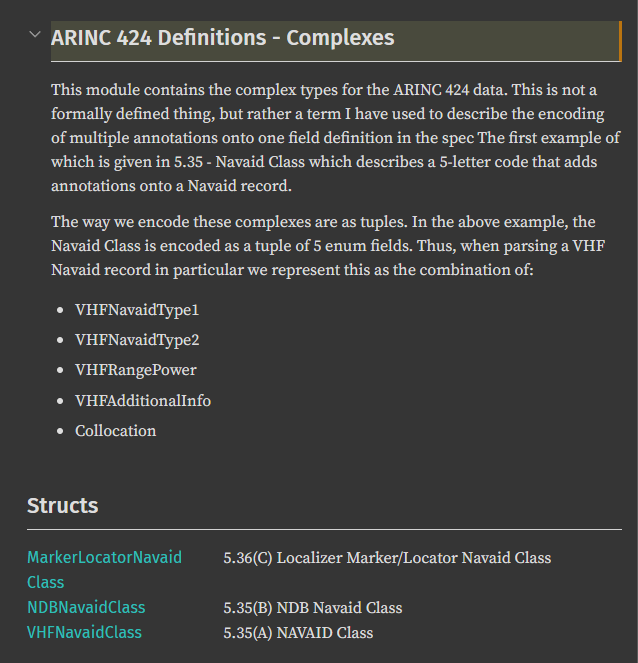
I used to try to look at what people are doing in machine-learning because it was the most relevant part of my job in the previous roles I held. However, I didn't really enjoy looking at papers and having to go through the rigor of evaluating if the paper I'm reading on Arxiv is inherently irreproducible (wish I had the energy to write about that). I shifted my focus to something within aviation data: the standards for both communication and data management. the communication stuff is something actually that I wrote about on X for a while now because I had experience in implementing some of the ideas therein, and if you look in my history you see a lot of posts around some of the more low-level comms stuff like TTP/C, AFDX or MIL-STD-1553. What is newer is looking at the older standards for data management still in use today, like ARINC 424, which I am currently building a more complete open-source parser for in Rust (Rust because of potential ferrocene adoption I see as likely in the industry). I am enjoying reading the (expensive) pdfs detailing the standard in all of its glory. I even have found some errata in published data with some preliminary work, and it's been much more enjoyable than anything I have done in the finance world. Perhaps it's because it is more aligned with my interests, or perhaps it's because relative to my career it is "new." Either way, I enjoy putting focus on this stuff. I have mostly been trying to find ways to better encapsulate the various rules, and have been mulling over helping the board in some more capacity once I am fully up to speed, since there is going to be a large focused transition from this older standard to a more XML-based way of encoding it, though this will need to be maintained for several more decades probably.
Aside from the aviation data stuff, I also have been exercising the skills in implementing robust communications buses. I have a sailboat, and it lacks some navionics. So I put together an idea to build my own navionics suite using some tricks from aviation regarding point-to-point hard-realtime deterministic and safe comms (based loosely on a TDMA protocol called TTP/C with some nice TLA+ verification). Is it necessary? no you could just slap it together and do web-services and it would be fine, we drive at 5 knots at most and aren't some heavy ship, and if something fails we are on water, not high up with risk of plummeting to the earth. Still, I think it's fun to revisit this stuff, and in reality it's not hard, just a bit tedious, but the kind of tedious like doing chores. Meditative I guess is the word. I also think it is fun to sometimes over-engineer things if only you are affected by that decision and the goal is to prod boundaries of what you can make fault tolerant. I will write some about this when I can, but I can't for now because it's very much just in the rough implementation phase where things are only lightly tested and real problems not known. I don't really know why I am now driven to do this stuff, but again my suspicion is it has to do with the headspace change related to shifting back to aviation.
Conclusion
Well, there really isn't one, I have a lot more to do now since my role is changing, but still I am overall quite happy with where I am now, but yes there was a lot to think about and a lot of shifts, and even if none of this was useful, I can only hope at least it was interesting enough to not be a burden to read and thanks for coming along for the ride. I hope to be able to post a lot more interesting things soon because of these changes in my life. Thanks to everyone I have engaged with over the past couple years - onward and upward.